
Here is a mistake I see all the time in the AI side hustle world.
Someone learns a few AI tools. They find a small business owner. They say, “I can build you an AI system!” Then they spend two weeks building something nobody asked for in that exact form. The client says, “Hmm, this is not really what I needed.” No payment. No trust. A lot of wasted time.
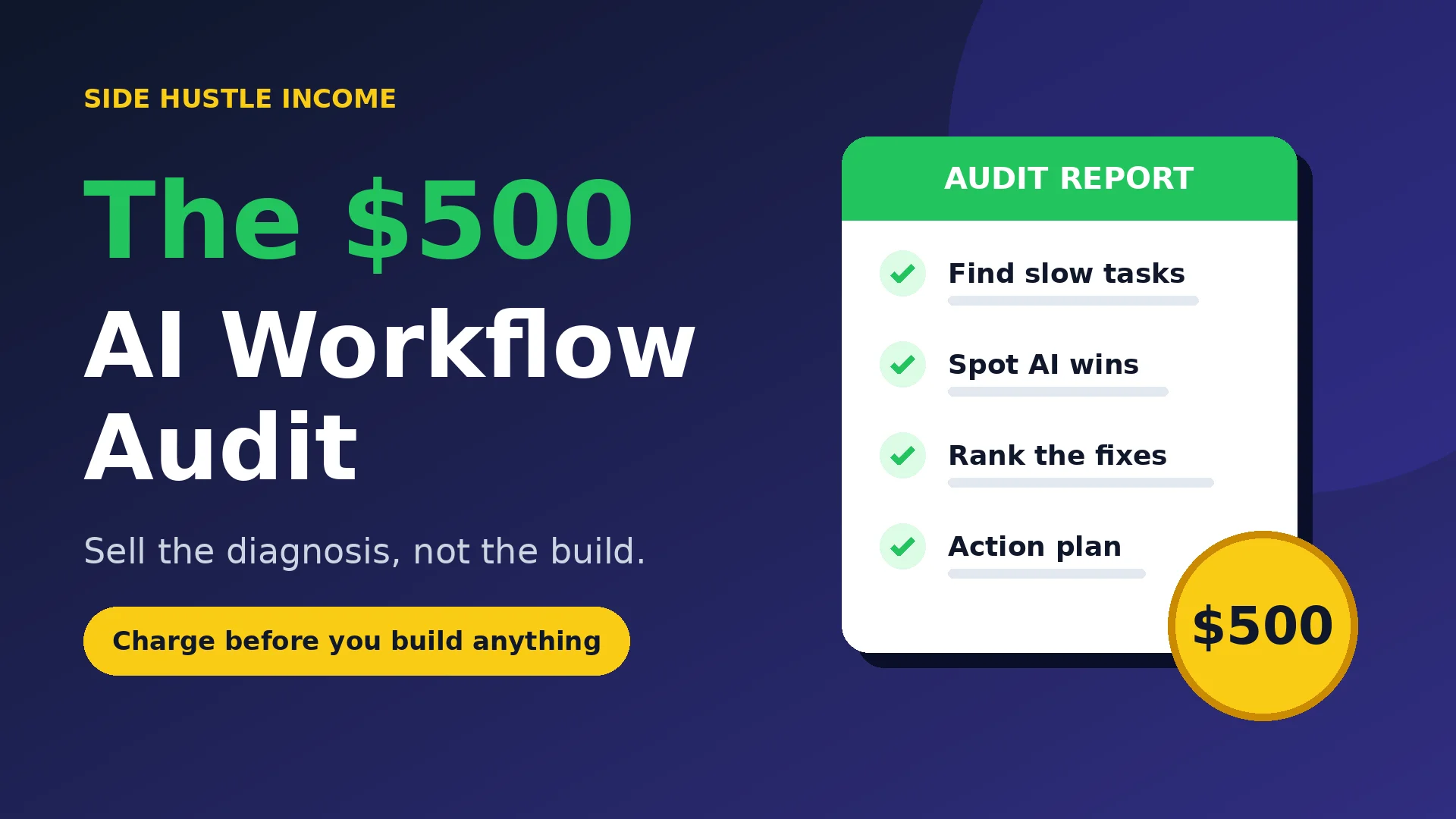
There is a much smarter way to start. Sell an AI workflow audit first. Charge $500. Get paid before you build anything.
In this post, I will show you exactly what an AI workflow audit is, why it works so well, and how you can sell your first one this week.
What Is an AI Workflow Audit?
An AI workflow audit is a short, paid review of how a business works day to day. You look at the repeated tasks, find the slow and boring parts, and show the owner where AI can save time or money.
Think of it like a doctor’s visit. The doctor does not start surgery the moment you walk in. First comes the check-up. Then the diagnosis. Then the treatment plan.
Your audit is the check-up and the diagnosis. The “build” is the treatment, and that comes later.
A good AI workflow audit answers three simple questions:
- Where is this business losing time?
- Which of those tasks can AI handle well?
- What should be fixed first for the biggest win?
Why You Should Sell the Diagnosis, Not the Build
This is the big idea, so let me make it very clear.
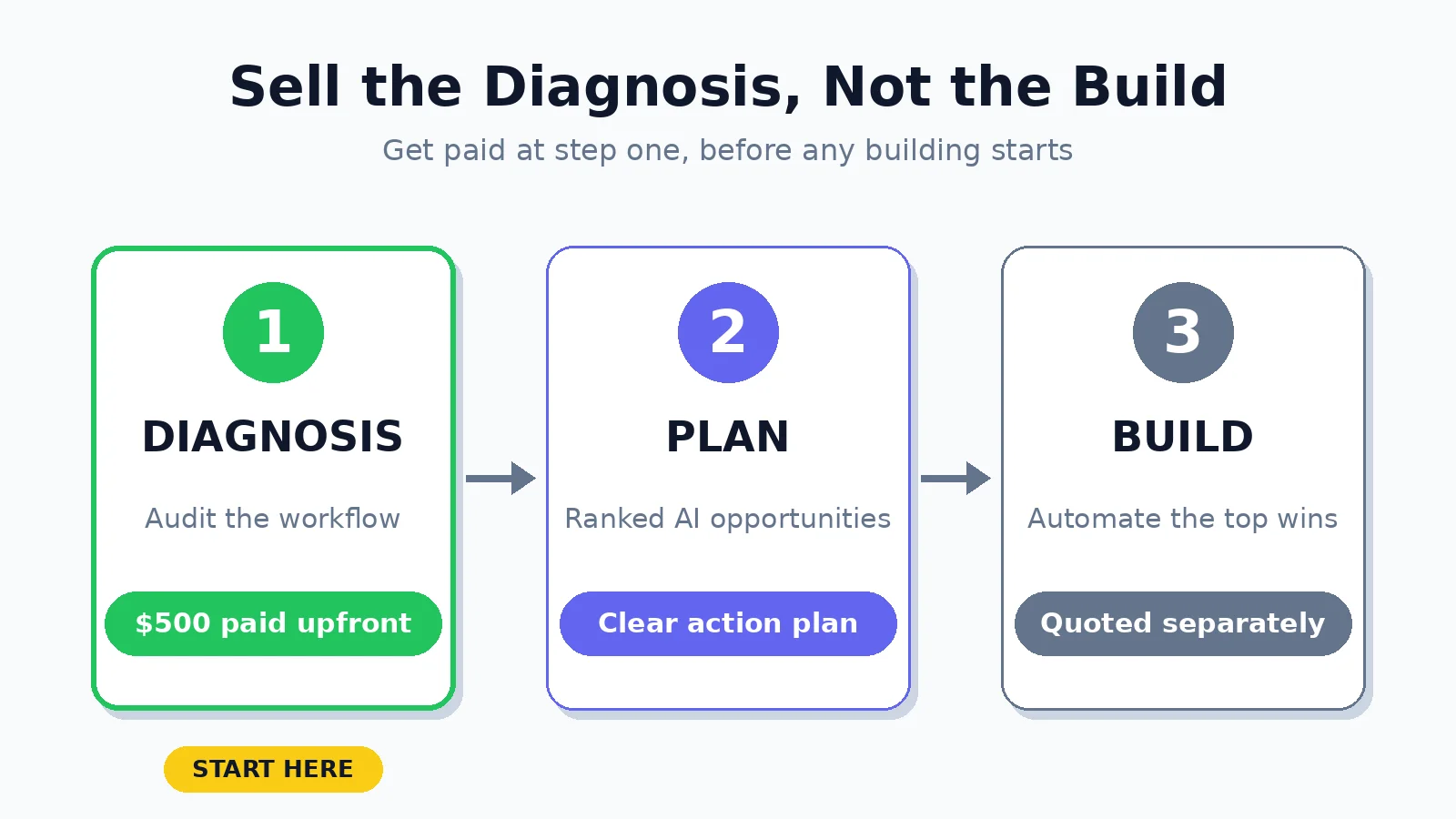
Most beginners sell the build. “I will create a chatbot.” “I will automate your emails.” The problem is that the client often does not know what they need yet. And you do not know either, until you look closely.
When you sell the diagnosis instead, a lot of good things happen.
You get paid first. The risk is gone. You are not working for free and hoping the client likes the result.
The price feels easy to say yes to. A $500 audit is a small decision. A $5,000 build is a big one. Most owners will say yes to small and think about big later.
You become the expert, not the order taker. People trust the person who tells them what is wrong. That trust makes the next sale much easier.
You avoid building the wrong thing. After the audit, you both know exactly what to build and why.
What the Client Gets for $500
The client is not paying for your time alone. They are paying for clarity. Keep the package simple so it is easy to deliver and easy to understand.
Here is what I suggest you include:
- A 45 to 60 minute call where you ask about their daily tasks and pain points
- A workflow map that shows how work moves through the business today
- A list of 3 to 5 AI opportunities, ranked from biggest win to smallest
- A time and money estimate for each opportunity (even a rough one is helpful)
- A simple action plan with what to do first, next, and later
Deliver it as a short PDF or a shared document. Five to eight pages is plenty. Clear beats long every time.
How to Run the Audit, Step by Step
You do not need to be a tech genius. You need to be curious and organized. Here is a simple process.
Step 1: Ask the right questions
Start with the owner’s week. Ask things like:
- What tasks do you repeat every single day?
- What do you hate doing?
- Where do customers wait the longest?
- What mistakes happen again and again?
People love to talk about what annoys them. Let them talk, and take notes.
Step 2: Map the workflow
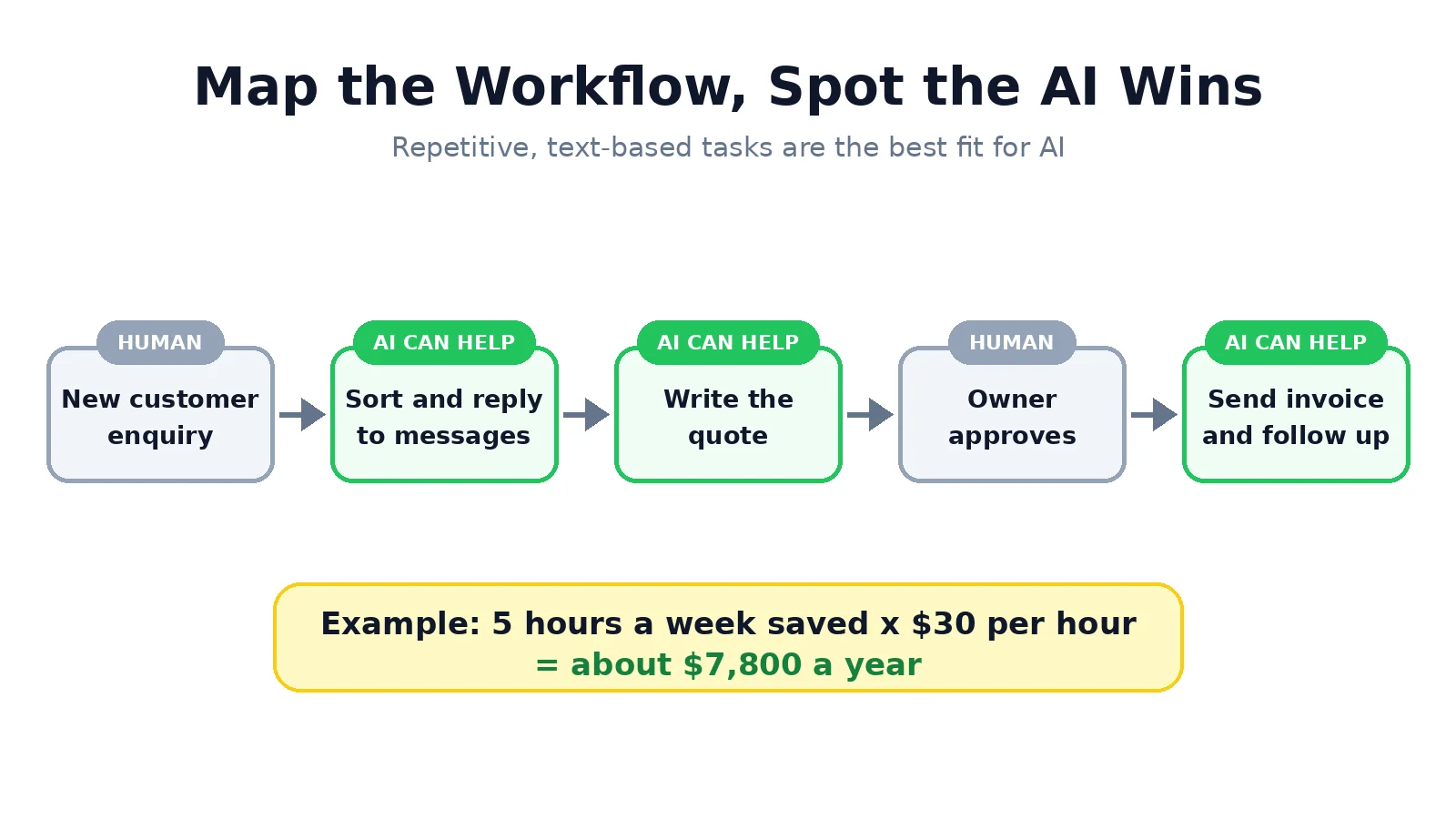
Draw the path of one task from start to finish. For example, how does a new customer enquiry become a paid order? Use boxes and arrows. You can use a free tool or even pen and paper.
Once you see the steps, the slow spots show up fast.
Step 3: Spot the AI opportunities
Look for tasks that are repetitive, based on text, and follow clear rules. These are the best fits for AI. Common examples:
- Writing first drafts of emails and replies
- Sorting and tagging customer messages
- Summarizing meetings or long documents
- Creating product descriptions or social posts
- Pulling key details from forms and invoices
Be honest, too. If a task needs human judgment or a personal touch, say so. Clients respect that.
Step 4: Rank and price the wins
Pick the top three to five ideas. For each one, write down the time saved per week and what that time is worth. If a task takes 5 hours a week and the owner’s time is worth $30 an hour, that is $150 a week, or roughly $7,800 a year. Numbers like these make your $500 look tiny.
Step 5: Deliver the plan
Present your findings in a short call or a screen share. Walk through the map, the opportunities, and your recommended first step. Then stop talking and let them react.
Why You Must Charge Before You Build
This part matters a lot, so I will say it plainly: get paid before you do the work.
When a client pays upfront, they take the process seriously. They show up to the call. They share real information. They read your report.
Free advice is often ignored. Paid advice gets used.
Send a simple invoice when the client says yes. Ask for payment before the call. Payment links make this easy, and it takes two minutes to set up.
A Simple Pitch You Can Copy
You do not need a fancy sales page. A short, friendly message is enough. Try this:
“Hi [Name], I help small businesses find where AI can save them time. I run a $500 AI workflow audit. In one week, I review how your team works, find the top 3 to 5 tasks AI can improve, and give you a clear plan with the expected time savings. If there is nothing worth automating, I will tell you honestly. Would you like me to send over the details?”
Send it to local shops, agencies, coaches, real estate agents, clinics, and online sellers. These businesses are busy, and many of them are curious about AI but do not know where to begin.
Common Mistakes to Avoid
Doing the audit for free. Free audits attract people who are not serious. Charge from day one.
Using too much tech talk. Say “saves you six hours a week,” not “leverages large language models.”
Promising too much. AI is powerful, but it is not magic. Set honest expectations and you will earn repeat work.
Skipping the numbers. Always connect your ideas to time saved or money earned. That is what owners care about.
Starting to build before the audit is paid. Even small “quick demos” can drift into unpaid work. Hold the line.
What Happens After the Audit?
Here is the best part. A good audit often leads to the next sale on its own.
The client now has a clear plan with your name on it. Many will ask, “Can you build this for us?” That is when you can quote a build, a monthly support plan, or a training session for their team.
Some clients will take the plan and walk away. That is fine. You still earned $500 for a few hours of focused work, and you can ask for a testimonial.
Do this three or four times and you will have case studies, confidence, and a repeatable offer.
Final Thoughts
The AI workflow audit is one of the easiest ways to enter the AI services world. You do not need to build anything first. You do not need a big portfolio. You just need to listen well, think clearly, and explain the next step in simple words.
Sell the diagnosis. Charge before you build. Let the client’s results do the talking.
Pick one small business this week, send one short message, and see what happens. Your first $500 audit could be closer than you think.

About Side Hustle Income
Side Hustle Income is your friendly guide to making extra money online. We share simple, practical ideas, real-world strategies, and step-by-step guides so you can start, grow, and enjoy your own side hustle, with no confusing jargon and no hype.
Enjoyed this post? Subscribe to Side Hustle Income and get fresh side hustle ideas and money-making tips delivered straight to your inbox. Join us today and take your next step toward extra income!